Plastic fibres found in tap water around the world, study reveals

Tests show billions of people globally are drinking water contaminated by plastic fibres, with 83% of samples found to be polluted.

Microplastic contamination has been found in tap water in countries around the world, leading to calls from scientists for urgent research on the implications for health. Scores of tap water samples from more than a dozen nations were analysed by scientists for an investigation by Orb Media, and overall, 83% of the samples were contaminated with plastic fibres.

The US had the highest contamination rate, at 94%, with plastic fibres found in tap water sampled at sites including Congress buildings, the US Environmental Protection Agency’s headquarters, and Trump Tower in New York. Lebanon and India had the next highest rates.

European nations including the UK, Germany and France had the lowest contamination rate, but this was still 72%. The average number of fibres found in each 500ml sample ranged from 4.8 in the US to 1.9 in Europe.

The new analyses indicate the ubiquitous extent of microplastic contamination in the global environment. Previous work has been largely focused on plastic pollution in the oceans, which suggests people are eating microplastics via contaminated seafood.

“We have enough data from looking at wildlife, and the impacts that it’s having on wildlife, to be concerned,” said Dr Sherri Mason, a microplastic expert at the State University of New York in Fredonia, who supervised the analyses for Orb. “If it’s impacting [wildlife], then how do we think that it’s not going to somehow impact us?” . . .

A magnified image of clothing microfibres from washing machine effluent.
Pinterest
 A magnified image of clothing microfibres from washing machine effluent. One study found that a fleece jacket can shed as many as 250,000 fibres per wash. Photograph: Courtesy of Rozalia Project


A separate small study in the Republic of Ireland released in June also found microplastic contamination in a handful of tap water and well samples. “We don’t know what the [health] impact is and for that reason we should follow the precautionary principle and put enough effort into it now, immediately, so we can find out what the real risks are,” said Dr Anne Marie Mahon at the Galway-Mayo Institute of Technology, who conducted the research.

Microplastics can attract bacteria found in sewage, Mahon said: “Some studies have shown there are more harmful pathogens on microplastics downstream of wastewater treatment plants.”

Image result for microplastic found in tap water

Microplastics are also known to contain and absorb toxic chemicals and research on wild animals shows they are released in the body. Prof Richard Thompson, at Plymouth University, UK, told Orb: “It became clear very early on that the plastic would release those chemicals and that actually, the conditions in the gut would facilitate really quite rapid release.” His research has shown microplastics are found in a third of fish caught in the UK.

This research led Frank Kelly, professor of environmental health at King’s College London, to tell a UK parliamentary inquiry in 2016: “If we breathe them in they could potentially deliver chemicals to the lower parts of our lungs and maybe even across into our circulation.” Having seen the Orb data, Kelly told the Guardian that research is urgently needed to determine whether ingesting plastic particles is a health risk.

The new research tested 159 samples using a standard technique to eliminate contamination from other sources and was performed at the University of Minnesota School of Public Health. The samples came from across the world, including from Uganda, Ecuador and Indonesia.

“We really think that the lakes [and other water bodies] can be contaminated by cumulative atmospheric inputs,” said Johnny Gasperi, at the University Paris-Est Créteil, who did the Paris studies. “What we observed in Paris tends to demonstrate that a huge amount of fibres are present in atmospheric fallout.”

Plastic fibres may also be flushed into water systems,  . . . and rains could also sweep up microplastic pollution, which could explain why the household wells used in Indonesia were found to be contaminated.

In Beirut, Lebanon, the water supply comes from natural springs but 94% of the samples were contaminated. “This research only scratches the surface, but it seems to be a very itchy one,” said Hussam Hawwa, at the environmental consultancy Difaf, which collected samples for Orb.
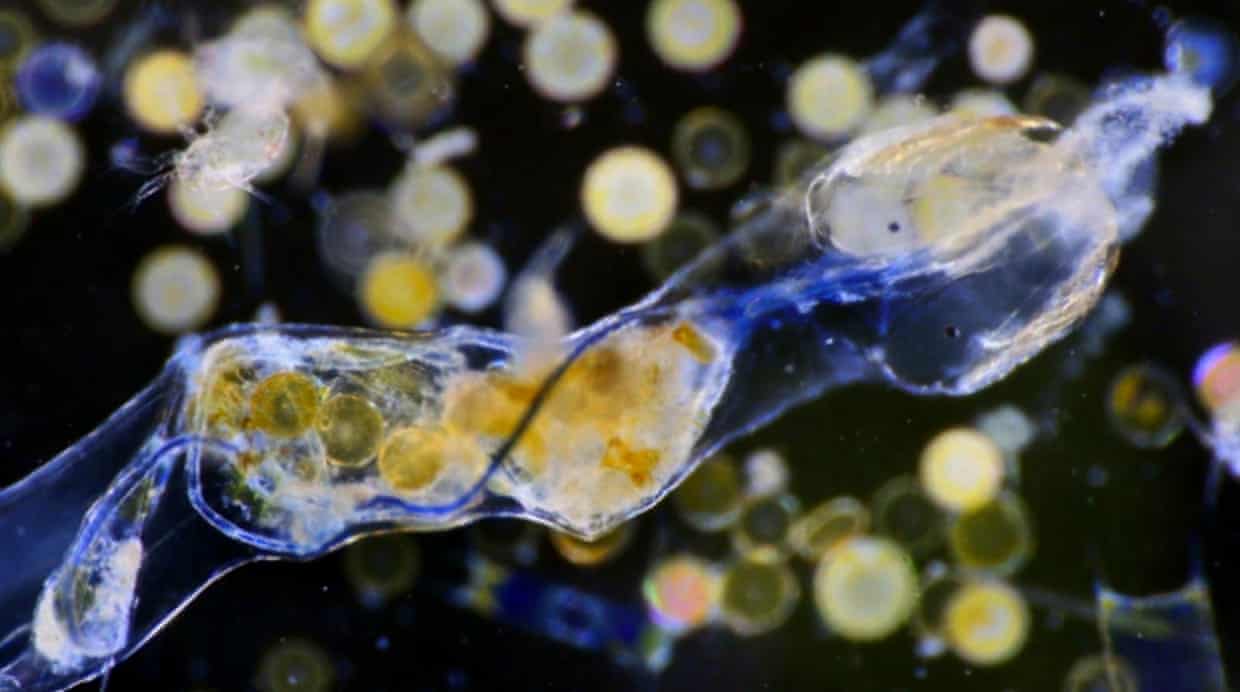
This planktonic arrow worm, Sagitta setosa, has eaten a blue plastic fibre about 3mm long.
Pinterest
This planktonic arrow worm, Sagitta setosa, has eaten a blue plastic fibre about 3mm long. Plankton support the entire marine food chain. Photograph: Richard Kirby/Courtesy of Orb Media

Bottled water may not provide a microplastic-free alternative to tap water, as the they were also found in a few samples of commercial bottled water tested in the US for Orb.

“We are increasingly smothering ecosystems in plastic and I am very worried that there may be all kinds of unintended, adverse consequences that we will only find out about once it is too late,” said Prof Roland Geyer, from the University of California and Santa Barbara, who led the study.

Mahon said the new tap water analyses raise a red flag, but that more work is needed to replicate the results, find the sources of contamination and evaluate the possible health impacts. . . .


By Damian Carrington, Environmental editor, The Guardian

September 6, 2017

READ FULL ARTICLE AT:

https://www.theguardian.com/environment/2017/sep/06/plastic-fibres-found-tap-water-around-world-study-reveals

Sea salt around the world is contaminated by plastic, studies show

Sea salt around the world is contaminated by plastic pollution, adding to experts’ fears that microplastics are becoming ubiquitous in the environment and finding their way into the food chain via the salt in our diets.

New studies have shown that tiny particles have been found in sea salt in the UK, France and Spain, as well as China and now the US.

Researchers believe the majority of the contamination comes from microfibres and single-use plastics such as water bottles, items that comprise the majority of plastic waste. Up to 12.7m tonnes of plastic enters the world’s oceans every year, equivalent to dumping one garbage truck of plastic per minute into the world’s oceans, according to the United Nations.

“Not only are plastics pervasive in our society in terms of daily use, but they are pervasive in the environment,” said Sherri Mason, a professor at the State University of New York at Fredonia, who led the latest research into plastic contamination in salt. Plastics are “ubiquitous, in the air, water, the seafood we eat, the beer we drink, the salt we use – plastics are just everywhere”.

Mason collaborated with researchers at the University of Minnesota to examine microplastics in salt, beer and drinking water. Her research looked at 12 different kinds of salt (including 10 sea salts) bought from grocery stores around the world.

Mason found Americans could be ingesting upwards of 660 particles of plastic each year, if they follow health officials’ advice to eat 2.3 grammes of salt per day.

The health impact of ingesting plastic is not known. Scientists have struggled to research the impact of plastic on the human body, because they cannot find a control group of humans who have not been exposed.

“Everybody is being exposed to some degree at any given time, from gestation through death,” researchers from Johns Hopkins Bloomberg School of Public Health and Arizona State University wrote in 2013. “Detectable levels of [the plastic] bisphenol A have been found in the urine of 95% of the adult population of the United States.”

Sea salt around the world is contaminated by plastic Photograph MirageC/Getty Images

. . . The research also comes after a Guardian analysis found 1m plastic bottles are purchased per minute, and that recycling efforts are failing to keep pace with production, which is expected to quadruple by 2050. Some environmentalists have said the threat of plastic pollution now “rivals climate change”.

Mason’s work adds to research on plastics in salt from other countries around the world, including in Spain and China.

In August, Spanish researchers concluded “sea products are irredeemably contaminated by microplastics” and there is “a background presence of microplastics in the environment”, in a study published in Scientific Reports in Nature. There, scientists tested 21 types of table salt and found plastic in all of them. The most common type of plastic they found was polyethylene terephthalate [PET], the material used to make plastic bottles.

This spring, a group of scientists from France, the UK and Malaysia tested 17 types of salt from eight different countries and examined what they believed were plastic particles. They found plastic in all but one sample and found the most of the plastic was from polyethylene and polypropylene.

Scientists first found plastics in salt in China in 2015. Microscopic plastic particles from face scrubs, cosmetics, and shards of plastic bottles were found in samples of 15 salt products found in Chinese grocery stores.

Some researchers, such as Mason, now believe sea salt could be more vulnerable to plastic contamination because of how it is made, through a process of dehydration of sea water.

“It is not that sea salt in China is worse than sea salt in America, it’s that all sea salt – because it’s all coming from the same origins – is going to have a consistent problem,” said Mason. “I think that is what we’re seeing.”

… Mason’s study also looked at how drinking water and beer are contaminated with plastic.  …’ We have to focus on the flow of plastic and the pervasiveness of plastics in our society and find other materials to be using instead.”

By Jessica Glenza in New York, The Guardian,

September 8, 2017

READ FULL ARTICLE at: https://www.theguardian.com/environment/2017/sep/08/sea-salt-around-world-contaminated-by-plastic-studies?CMP=share_btn_fb


Plastic fibres found in tap water around the world, study reveals

Tests show billions of people globally are drinking water contaminated by plastic particles, with 83% of samples found to be polluted.

Microplastic contamination has been found in tap water in countries around the world, leading to calls from scientists for urgent research on the implications for health.

Scores of tap water samples from more than a dozen nations were analysed by scientists for an investigation by Orb Media, who shared the findings with the Guardian. Overall, 83% of the samples were contaminated with plastic fibres.

The US had the highest contamination rate, at 94%, with plastic fibres found in tap water sampled at sites including Congress buildings, the US Environmental Protection Agency’s headquarters, and Trump Tower in New York. Lebanon and India had the next highest rates.

European nations including the UK, Germany and France had the lowest contamination rate, but this was still 72%. The average number of plastic fibres found in each 500ml sample ranged from 4.8 in the US to 1.9 in Europe.

The new analyses indicate the ubiquitous extent of microplastic contamination in the global environment. Previous work has been largely focused on plastic pollution in the oceans, which suggests people are eating microplastics via contaminated seafood.

“We have enough data from looking at wildlife, and the impacts that it’s having on wildlife, to be concerned,” said Dr Sherri Mason, a microplastic expert at the State University of New York in Fredonia, who supervised the analyses for Orb. “If it’s impacting [wildlife], then how do we think that it’s not going to somehow impact us?”

Mahon said there were two principal concerns: very small plastic particles [like plastic fibres] and the chemicals or pathogens that microplastics can harbour. “If the fibres are there, it is possible that the nanoparticles are there too that we can’t measure,” she said. “Once they are in the nanometre range they can really penetrate a cell and that means they can penetrate organs, and that would be worrying.” The Orb analyses caught particles of more than 2.5 microns in size, 2,500 times bigger than a nanometre.

Microplastics can attract bacteria found in sewage, Mahon said: “Some studies have shown there are more harmful pathogens on microplastics downstream of wastewater treatment plants.”

Microplastics are also known to contain and absorb toxic chemicals and research on wild animals shows they are released in the body. Prof Richard Thompson, at Plymouth University, UK, told Orb: “It became clear very early on that the plastic would release those chemicals and that actually, the conditions in the gut would facilitate really quite rapid release.” His research has shown microplastics are found in a third of fish caught in the UK.

  A magnified image of clothing microfibres from washing machine effluent. One study found that a fleece jacket can shed as many as 250,000 fibres per wash. Photograph: Courtesy of Rozalia Project

… The scale of global microplastic contamination is only starting to become clear, with studies in Germany finding fibres and fragments in all of the 24 beer brands they tested, as well as in honey and sugar. In Paris in 2015, researchers discovered microplastic falling from the air, which they estimated deposits three to 10 tonnes of fibres on the city each year, and that it was also present in the air in people’s homes. As well, a leading health expert in London has warned that people could be breathing in microparticles of plastic, with as yet unknown consequences on health.

Current standard water treatment systems do not filter out all of the microplastics, Mahon said: “There is nowhere really where you can say these are being trapped 100%. In terms of fibres, the diameter is 10 microns across and it would be very unusual to find that level of filtration in our drinking water systems.”

Bottled water may not provide a microplastic-free alternative to tapwater, as the they were also found in a few samples of commercial bottled water tested in the US for Orb.

… “We are increasingly smothering ecosystems in plastic and I am very worried that there may be all kinds of unintended, adverse consequences that we will only find out about once it is too late,” said Prof Roland Geyer, from the University of California and Santa Barbara, who led the study.

READ FULL ARTICLE at: https://www.theguardian.com/environment/2017/sep/06/plastic-fibres-found-tap-water-around-world-study-reveals

By Damian Carrington Environment editor, The Guardian, September 6, 2017

An alternative to plastic wrap

etee Reusable Food Wrap provides a non-toxic, sustainable, and biodegradable alternative to plastic wrap, zip-lock bags, sandwich bags & bulky food storage containers.

From their website –

A Natural way to Preserve Your Food Preserve your food and protect your family – naturally – with these reusable food wraps.

Non-toxic | Plastic Free
Sustainable | Reusable
Biodegradable | Compostable

FOR MORE INFORMATION SEE: https://www.shopetee.com/pages/reusable-food-wrap-offer

A Mission to the Pacific Plastic Patch in the South Pacific Gyre

Capt. Charles Moore, a mariner who has spent years travelling “hundreds of thousands of nautical miles” to measure the impact of plastic waste in the ocean has estimated that a “raft” of plastic debris spanning more than 965,000 square miles (2.5m sq km) is concentrated in a region of the South Pacific.  He was part of the team which discovered the first ocean “garbage patch” in the North Pacific gyre in 1997 and has now turned his attention to the South Pacific gyre.

Moore has just returned from a sampling expedition around Easter Island and Robinson Crusoe Island.

  Capt. Charles Moore has been researching the ocean for plastic since 1997. Source: ALGALITA

Although plastic is known to occur in the Southern Hemisphere gyres, very few scientists have visited the region to collect samples.

Oceanographer Dr Erik van Sebille, from Utrecht University, says the work of Capt Moore and his colleagues will help fill “a massive knowledge gap” in our understanding of ocean plastics.

“Any data we can get our hands on is good data at this point,” he told BBC News.

Capt Moore explained that the space occupied by sub-tropical gyres – areas of the ocean surrounded by circulating ocean currents – is approximately the same size as the entire land mass of the Earth, but they are now being “populated by our trash”.

… “It’s hard not to find plastic in the ocean any more,” Dr van Sebille said. “That’s quite shocking”.

  Our plastic rubbish has floated to islands that are thousands of miles from the nearest human population. Source: SPL

Capt Moore is the founder of Algalita Marine Research, a non-profit organisation aiming to combat the “plastic plague” of garbage floating in the world’s oceans.

For more than 30 years, he has transported scientists to the centre of remote debris patches aboard his research ship, Alguita.

Dragging nets behind the vessel, the crew sieves particles of plastic from the ocean, which are then counted and fed into estimates of global microplastic distribution.

Although scientists agree that plastic pollution is a widespread problem, the exact distribution of these rafts of ocean garbage is still unclear.

“If we don’t understand where the plastic is, then we don’t really understand what harm it does and we can’t really work on solving the problem,” said Dr van Sebille.

Eating rubbish

Capt Moore and his crew hope to address this lack of data through their research trips.

On this latest voyage, Capt Moore and his colleagues are also investigating how plastic in the South Pacific Ocean may be threatening the survival of fish.

Lanternfish, that live in the deep ocean, are an important part of the diet of whales, squid and king penguins and the Algalita team says that plastic ingestion by lanternfish could have a domino effect on the rest of the food chain.

Little lantern fish are smaller than your finger and live so deep that very few people have ever seen one alive.  Every night, all around the world, this false bottom of fish rises up just a bit from the depths of the sea, eats heaps of carbon-rich plankton, and then drops back down again and poops carbon.  In a world in which carbon emissions have become an enormous ecological threat, and in an era when great minds are searching for ways to achieve carbon sequestration to remove it from the atmosphere, it is amazing to consider that these tiny lantern fish sink far more carbon than all of the world’s forests combined.
 

… Christiana Boerger, a marine biologist in the US Navy, has seen the impact of oceanic garbage patches first hand, aboard the Alugita and she says that some fish species “have more man-made plastic in their stomach than their natural food”.

… Capt Moore says the South Pacific Gyre garbage patch is different from those in the Northern Hemisphere, because most of the litter appears to have come from the fishing industry.

Elsewhere, scientists are shifting their attention away from remote mid-ocean garbage patches to locations closer to home.

“If you think about plastic in terms of its impact, where does it harm marine life?” Dr van Sebille posed.

“Near coastlines is where biology suffers. It’s also where the economy suffers the most.” …

FEATURED IMAGE:  South Pacific garbage patch – Most of the plastic is made up of tiny pieces floating at the surface.  Source: ALGALITA


READ FULL ARTICLE AND WATCH VIDEO AT:

A mission to the Pacific plastic patch

July 16, 2017


Plastic drinking straws may be the most unnecessary plastic product we use

Of all the plastic products we use and take for granted, plastic drinking straws are among the most unnecessary. Designed to be used once and discarded, their only real purpose is to keep your mouth from touching a glass or ice. It made more sense in the days when contaminated vessels were more of an issue.

Now, there’s a movement to get people and businesses to ditch the straws. It may not seem like a big deal, but it is. In the U.S. alone, people discard 500 million straws every day, or more than 180 billion a year. That’s about 1.4 million kilograms of plastic sent to landfills and into the oceans every day!

Drinking straws have a long history and weren’t always a big problem. The first ones were made from straw, or any strawlike grass or plant. That changed in the 1880s when Washington, D.C., resident Marvin Stone was drinking a mint julep through a rye grass stalk. He didn’t like the residue it left in his drink, and so he wrapped paper around a pencil, removed the pencil, glued the paper together and a straw was born! In 1888, Stone patented a version made from manila paper coated with paraffin.

… The explosion of plastic’s popularity in the 1960s and into the ’70s spelled the demise of the paper straw. After that, most drinking straw innovations were as much about marketing as function — including the twisty Krazy Straw and the wide straw-and-spoon combo used to drink slushy drinks.

Plastic straws are now ubiquitous. Whether you’re ordering a takeout drink, cold coffee beverage, bar cocktail or glass of water in a restaurant, you’ll likely get a plastic straw unless you request your drink without it. And you should. As a Treehugger article notes, they don’t biodegrade, they’re difficult to recycle, they leach toxic chemicals into the ground and they can end up in oceans. Often, they’re incinerated, which puts toxins into the air.

Numerous campaigns have sprung up to get people to forgo drinking straws — or at least to use less environmentally damaging alternatives. Some restaurants have stopped automatically putting them in drinks, and others are using compostable straws, but most still offer plastic. International spirits company Bacardi has joined with the Surfrider Foundation for a “no-straw movement” as part of its Good Spirited: Building a Sustainable Future program. Surfrider, which has led campaigns against plastic bags, discarded cigarette butts and other ocean threats, has a “Straws Suck” campaign that encourages businesses to get rid of straws. In doing so, bars, restaurants and stores can save money as well as reduce environmental impacts.

As for alternatives, several companies sell re-usable and biodegradable straws made from metal, glass, bamboo, straw or paper. Some come with cleaning brushes. One company is even making straws from pasta, which can be cooked later!

… Avoiding plastic straws won’t save the oceans or the world on its own, but as we’ve seen with plastic bags and public smoking, when people start thinking about their habits and making small changes, they can bring about shifts in consciousness that lead to wider societal changes. Ordering your drinks without straws is a small sacrifice but a big step to reducing the amount of plastic we produce and waste. Giving up disposable drink bottles, plastic grocery bags and other unnecessary plastic items, and encouraging businesses to offer alternatives, will also help.

David Suzuki ~ Plastic Straws Suck

David Suzuki ~ Plastic Straws Suck

Why aren’t the bottles Coca-cola uses 100% recycled?

If you care so much, Coca-cola, why aren’t your bottles 100% recycled?

Coca-Cola sells more than 100bn single-use plastic bottles a year – that’s more than 3,000 every second. Its plans to increase recycled plastic in its bottles to 50% are startlingly unambitious.

Coca-Cola’s grand announcement on plastic packaging is a lot of PR fizz. But when you look at the detail, it’s all a bit flat.

The news that the company is to increase the amount of recycled plastic in its bottles to 50% shows a startling lack of ambition from the soft-drinks giant to tackle one of the greatest environmental challenges facing us: the plastic pollution choking our oceans.

Turns out when Coca-Cola’s distinctive bottles turn up on beaches, and contribute to the rubbish truck of plastic (pdf) entering the ocean every minute, that isn’t so good for brand image.

The soft drinks giant has come under attack for its meagre recycled content and failure to move away from single-use packaging that is devastating marine life.

This new plan is no game changer. Limited to operations in the UK, Coca-Cola’s plans amount to increasing its existing target for recycled content by a mere 10%, launching yet another public awareness campaign to keep the focus on litterers, and trialling what appears will be little more than a promotional scheme for buying more Coca-Cola bottles.

The company’s plans, which it says it will reveal later this year, may feature a money-off voucher scheme to reward customers returning small Coca-Cola bottles to shops. This would be a cheap gimmick to try and move the story on from Coca-Cola’s major U-turn on deposit return schemes after Greenpeace revealed the company had been lobbying against these in Holyrood, Westminster and Brussels. If the vouchers can be redeemed on yet more plastic Coca-Cola bottles, this will only boost the already staggering global plastic bottle sales of a million a minute.

[One thing that doesn’t seem to get discussed are the plastic bottle labels, which readily come off and end up littered on beaches.]

It’s also worth pointing out that Coca-Cola’s mildly higher goal to source 50% recycled content should be taken with a pinch of salt given the company’s history of failing to keep its promises. Coca-Cola got less than half way to meeting its global 2015 target to source 25% of its plastic bottles from recycled or “renewable” material, for example plant-based plastics. Globally the company reached a pitiful 7% recycled material.

Even putting these doubts aside, is reaching 50% recycled content in three years’ time significant? The truth is that 100% recycled bottles are feasible and have been rolled out for a number of soft drinks products over the past decade. In 2007, for example, Suntory’s Ribena became the first major UK soft drink brand to use 100% recycled plastic. Coca-Cola, the world’s biggest soft drinks company, is lagging far behind.

Featured image:  Coke bottles found by Greenpeace volunteers on a beach in Mull.

READ FULL ARTICLE AT:  If you care so much, Coke, why aren’t your bottles 100% recycled?

By John Sauven, Guardian Sustainable Business

July 13, 2017

https://www.theguardian.com/sustainable-business/2017/jul/13/coca-cola-plastics-pollution-oceans-bottles-packaging-recycling-pr-fizz-greenpeace-john-sauven?CMP=share_btn_fb


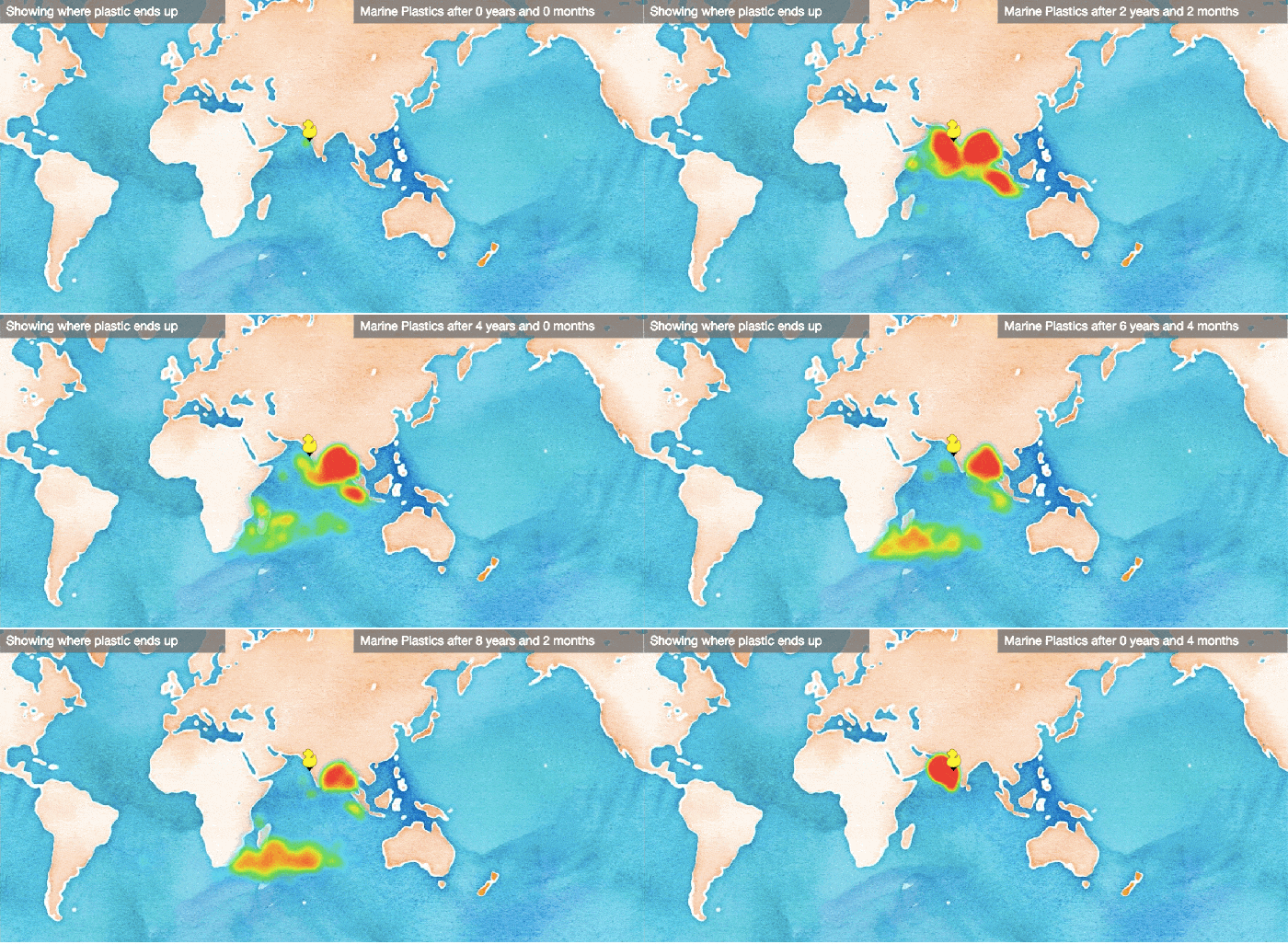
If you drop plastic in the ocean, where do the ocean currents take it?

Modelling shows that ocean currents can concentrate slow-degrading debris in certain parts of the world’s oceans, leading to so-called ‘garbage patches’.

Shanghai
 A bottle dropped in the water off the coast of China is likely be carried eastward by the north Pacific gyre and end up a few hundred miles off the coast of the US. Photograph: Graphic

It is estimated that between four and 12m metric tonnes of plastic makes its way into the ocean each year. This figure is only likely to rise, and a 2016 report predicted that by 2050 the amount of plastic in the sea will outweigh the amount of fish.

. . . A lot of plastic debris in the ocean breaks down into smaller pieces and is ingested by marine life, and it is thought that a significant amount sinks to the sea bed. But a lot of it just floats around, and thanks to sophisticated modelling of ocean currents using drifting buoys, we can see where much of it ends up.

Oceanographer Erik van Sebille, who works at Imperial College London and Utrecht University in the Netherlands, has shown that thanks to strong ocean currents known as gyres, huge amounts of plastic end up in “garbage patches” around the world, the largest one being in the north Pacific.

As can be seen in the image above, a bottle dropped in the water off the coast of China, near Shanghai, is likely be carried eastward by the north Pacific gyre and end up circulating a few hundred miles off the coast of the US.

A bottle dropped off the Mexican coast, near Acapulco, is likely to be caught in the same gyre. Some of the plastic waste drifts south, but a huge amount is swept west towards Asia before floating north and ending up in the same area – the so-called Great Pacific Garbage Patch [aka Pacific Trash Vortex].

The North Atlantic is home to another powerful current. The image below shows what happens to plastic debris that enters the ocean around New York. Initially a lot of it heads over to Europe, with concentration in the Bay of Biscay and, to a lesser extent, the North Sea, but the majority is trapped by the current and ends up floating in the middle of the ocean.

It’s a similar story in the UK. A bottle dropped in the sea off Cornwall may well be dragged through the channel towards Scandinavia, but the greatest concentrations are again in the Bay of Biscay and the western North Atlantic.

India is one of the world’s biggest plastic polluters, creating more than 15,000 tonnes of plastic waste a day. The plastic waste that enters the water around Mumbai is likely to end up either being caught in the Indian Ocean gyre and floating close to Madagascar, or being swept east and into the Bay of Bengal, one of the worst places in the world for plastic pollution

You can explore further modelling on Van Sebille’s website, Plastic Adrift.


By Alan Evans, The Guardian

June 29, 2017

https://www.theguardian.com/environment/2017/jun/29/if-you-drop-plastic-in-the-ocean-where-does-it-end-up

This biodegradable water bottle breaks down when it’s empty

Your water bottle could one day start to biodegrade the moment you finish drinking, if a visionary piece of design becomes reality.

The brainchild of Icelandic product design student Ari Jónsson, the water bottle holds its shape until you’ve drained it. As soon as it’s empty, the bottle will start to decompose.

As he argued in Dezeen Magazine: “Why are we using materials that take hundreds of years to break down in nature to drink from once and then throw away?”

How does it work?

The water bottle is made from a powdered form of agar – a substance obtained from algae. When this powder is mixed with water it becomes a jelly-like material, which can be moulded into a shape of your choosing.

Jónsson explained in an article with Co.Exist that the mix of algae and water produces the perfect lifespan for the bottle. It needs liquid to hold its shape, but once it’s empty it begins to break down.

He argues that the water is entirely safe to drink, although it might take on a bit of a salty taste after a while. You could even eat the bottle, which is said to taste a bit like “seaweed jello”.

At the moment the design is little more than a concept, but Jónsson hopes it will get people thinking about the problem and consider developing their own solutions.

In 2014, the world produced 311 million tonnes of plastic, much of which ended up in landfill or the ocean.  According to a World Economic Forum report, by 2050 the oceans are predicted to contain more plastic than fish.

By Joe Myers, World Economic Forum

April 1, 2016

READ FULL ARTICLE AT: https://www.weforum.org/agenda/2016/04/this-biodegradable-water-bottle-breaks-down-when-it-s-empty?utm_content=buffer397b6&utm_medium=social&utm_source=facebook.com&utm_campaign=buffer

Scientists find 38 million pieces of trash on Pacific island

Researchers say density of trash the highest recorded anywhere despite island’s extreme remoteness

In this 2015 photo provided by Jennifer Lavers, a crab uses a piece of plastic debris as shelter on the beach on Henderson Island. (Jennifer Lavers/Associated Press)

When researchers travelled to a tiny, uninhabited island in the middle of the Pacific Ocean, they were astonished to find an estimated 38 million pieces of trash washed up on the beaches.

Almost all of the garbage they found on Henderson Island was made from plastic. There were toy soldiers, dominos, toothbrushes and hundreds of hardhats of every shape, size and colour.

The researchers say the density of trash was the highest recorded anywhere in the world, despite Henderson Island’s extreme remoteness. The island is located about halfway between New Zealand and Chile and is recognized as a UNESCO world heritage site.

Jennifer Lavers, a research scientist at Australia’s University of Tasmania, was lead author of the report, which was published Tuesday in Proceedings of the National Academy of Sciences.

Lavers said Henderson Island is at the edge of a vortex of ocean currents known as the South Pacific gyre, which tends to capture and hold floating trash.

The quantity of plastic is ‘both beautiful and terrifying.’ (Jennifer Lavers/Associated Press)

“The quantity of plastic there is truly alarming,” Lavers told The Associated Press. “It’s both beautiful and terrifying.”

She said she sometimes found herself getting mesmerized by the variety and colours of the plastic that litters the island before the tragedy of it would sink in again.

Lavers and six others stayed on the island for 3 1/2 months in 2015 while conducting the study. They found the trash weighed an estimated 17.6 tons and that more than two-thirds of it was buried in shallow sediment on the beaches.

Lavers said she noticed green toy soldiers that looked identical to those her brother played with as a child in the early 1980s, as well as red motels from the Monopoly board game.

She said the most common items they found were cigarette lighters and toothbrushes. One of the strangest was a baby pacifier.

‘Rethink our relationship with plastic’

She said they found a sea turtle that had died after getting caught in an abandoned fishing net and a crab that was living in a cosmetics container.

By clearing a part of a beach of trash and then watching new pieces accumulate, Lavers said they were able to estimate that more than 13,000 pieces of trash wash up every day on the island, which is about 10 kilometres (6 miles) long and 5 kilometres (3 miles) wide.

Henderson Island is part of the Pitcairn Islands group, a British dependency. It is so remote that Lavers said she missed her own wedding after the boat coming to collect the group was delayed.

Researchers were astonished to find an estimated 38 million pieces of trash washed up on the beaches.(Jennifer Lavers/Associated Press)

Luckily, she said, the guests were still in Tahiti, in French Polynesia, when she showed up three days late, and she still got married.

Lavers said she is so appalled by the amount of plastic in the oceans that she has taken to using a bamboo iPhone case and toothbrush.

“We need to drastically rethink our relationship with plastic,” she said. “It’s something that’s designed to last forever, but is often only used for a few fleeting moments and then tossed away.”

Melissa Bowen, an oceanographer at the University of Auckland in New Zealand who was not involved in the study, said that winds and currents in the gyre cause the buildup of plastic items on places like Henderson Island.

“As we get more and more of these types of studies, it is bringing home the reality of plastic in the oceans,” Bowen said.


The Associated Press

May 16, 2017

https://www.cbc.ca/news/technology/trash-pacific-1.4117224

Researchers Race to find the Source of Microplastics Choking the World’s Oceans

Groundbreaking research into one of the world’s most complex pollution problems, microplastics, is underway at B.C. labs.  Scientists are growing increasingly concerned about microplastics in water and in the food chain, but they face some daunting challenges in the race to uncover the sources of the problem.

“We’re encountering a pollutant unlike any pollutant we’ve ever seen before,” says Dr. Peter Ross, director of ocean pollution research at the Vancouver Aquarium. “This is not a chemical pollutant, it’s a structural pollutant.”

Recent samples his team have taken off the B.C. coast contained up to 25,000 plastic particles and fibres in just one cubic metre of water.

Yes, some of it comes from plastic bags, foam packaging, cigarette butts and other remnants of the millions of tonnes of plastic debris slowly breaking down in the world’s oceans.

But there are some surprising sources, too, like laundry.

“A single sweater could release as much as 10,000 particles of microplastic fibres,” said Ross.

“That’s getting into the wastewater stream, and you have a million or two million people doing such laundry — it adds up.”

This water sample taken by researchers in B.C.’s Strait of Georgia contained an average of 3,200 plastic particles per cubic metre of ocean. Other samples off Vancouver contained up to 25,000 particles. (Vancouver Aquarium)

Sewage treatment plants may hold answers

But no one knows yet how washing your favourite fleece jacket fits into the bigger picture.

To find out, Ross is working with sewage treatment plants to measure the number and types of fibres in the water coming in, and later sampling the treated water as it flows out into the Fraser River to compare.

What they find could lead to changes in filtering techniques at treatment plants.

Water sampling is also being done out in the open ocean, revealing a mix of fibres and other microplastics, defined as anything smaller than five millimetres in size.

It’s a global issue, so everyone has an interest in reducing the amount of plastic being added to the world’s waterways. One estimate puts it at the equivalent of a garbage truckload every minute. At this rate, by 2050 there will be more plastic in the ocean than fish.

To home in on the problem, technicians at the Vancouver Aquarium lab recently began using a $325,000 infrared spectrometer like the kind usually found in crime labs.

It can identify the type of plastic from tiny samples.

‘It’s not going to give us the exact fingerprint,” says Ross. “It won’t say ‘Walmart fleece made in China,’ but it will confirm it is plastic, give us the category, tell us about additives and sometimes actually a manufacturer.”

. . .

Featured image:

This microscopic image shows a tiny zooplankton tangled in a microplastic fibre. Plankton are part of the diet for some bigger fish and give the microplastics a gateway into the food supply. (Vancouver Aquarium)

READ FULL ARTICLE:

B.C. researchers race to find the source of microplastics choking the world’s oceans

By Greg Rasmussen, CBC NEWS, March 11, 2017

http://www.cbc.ca/news/canada/british-columbia/bc-microplastics-research-1.4017502

Sperm Whales Found Full of Car Parts and Plastic

A fishing net, part of a car engine, and plastic buckets were found in the stomachs of 13 sperm whales which washed up on a German beach

Fishing gear and an engine cover are just some of the startling contents found inside the stomachs of sperm whales that recently beached themselves on Germany’s North Sea coast.

The 13 sperm whales washed up near the German state of Schleswig-Holstein earlier this year, the latest in a series of whale strandings around the North Sea. So far, more than 30 sperm whales have been found beached since the start of the year in the U.K., the Netherlands, France, Denmark, and Germany.

After a necropsy of the whales in Germany, researchers found that four of the giant marine animals had large amounts of plastic waste in their stomachs. The garbage included a nearly 43-foot-long (13-meter-long) shrimp fishing net, a plastic car engine cover, and the remains of a plastic bucket, according to a press release from Wadden Sea National Park in Schleswig-Holstein.

However, “the marine litter did not directly cause the stranding,” says Ursula Siebert, head of the Institute for Terrestrial and Aquatic Wildlife Research at the University of Veterinary Medicine Hannover, whose team examined the sperm whales.

Instead, the researchers suspect that the whales died because the animals accidentally ventured into shallow seas.

. . . According to the WDC, whales and dolphins may strand for many reasons, such as excessive noise pollution from ships and drilling surveys or even subtle shifts in Earth’s magnetic field. In addition, pilot whales that beached off the coast of Scotland three years ago showed high levels of toxins from ocean pollution, which scientists linked to stress on their brains that may have caused disorientation.


Schleswig-Holstein environment minister Robert Habeck holds debris found inside beached sperm whales in a picture posted to Instagram.  (Photo Robert Habeck,Instagram)

Sperm whale swims near the Azores in the Atlantic Ocean. Photography by Brian Skerry, National Geographic Creative

. . . Siebert adds that if the whales had survived, the garbage in their guts might have caused digestive problems down the line. At the time of death, the animals were in decent shape and, in addition to the debris, the scientists found thousands of squid beaks in the whales’ stomachs.

But when whales and dolphins ingest lots of marine litter, either accidentally or because they mistake the trash for prey, it can cause physical damage to their digestive systems. The trash may eventually give the animals the sensation of being full and reduce their instinct to feed, leading to malnutrition.

While the garbage may not have been lethal for these whales, “the plastic debris in their stomachs is a horrible indictment of humans,” adds Hal Whitehead, a whale researcher at Dalhousie University in Nova Scotia, Canada.

Featured image: Sperm whales found with ingested car parts and other plastic. Photo credit: Facebook

READ FULL ARTICLE AT:

Sperm Whales Found Full of Car Parts and Plastic

Under a business-as-usual scenario, there will be more plastic than fish (by weight) by 2050. Plastic packaging plays a major role in the amount of plastic entering the oceans.

By 2050, the ocean is expected to contain more plastic than fish – major source: plastic packaging

Plastics and plastic packaging are an integral and important part of the global economy. Plastics production has surged over the past 50 years, from 15 million tonnes in 1964 to 311 million tonnes in 2014, and is expected to double again over the next 20 years, as plastics come to serve increasingly many applications. Plastic packaging, the focus of this report, is and will remain the largest application; currently, packaging represents 26% of the total volume of plastics used. Plastic packaging not only delivers direct economic benefits, but can also contribute to increased levels of resource productivity – for instance, plastic packaging can reduce food waste by extending shelf life and can reduce fuel consumption for transportation by bringing packaging weight down.

While delivering many benefits, the current plastics economy also has important drawbacks that are becoming more apparent by the day. Today, 95% of plastic packaging material value, or $80–120 billion annually, is lost to the economy after a short first use. More than 40 years after the launch of the first universal recycling symbol, only 14% of plastic packaging is collected for recycling. When additional value losses in sorting and reprocessing are factored in, only 5% of material value is retained for a subsequent use. Plastics that do get recycled are mostly recycled into lower-value applications that are not again recyclable after use. The recycling rate for plastics in general is even lower than for plastic packaging, and both are far below the global recycling rates for paper (58%) and iron and steel (70–90%). In addition, plastic packaging is almost exclusively single-use, especially in business-to-consumer applications.

Plastic packaging generates significant negative externalities, conservatively valued by UNEP at $40 billion and expected to increase with strong volume growth in a business-as-usual scenario. Each year, at least 8 million tonnes of plastics leak into the ocean – which
is equivalent to dumping the contents of one garbage truck into the ocean every minute. If no action is taken, this is expected to increase to two per minute by 2030 and four per minute by 2050. Estimates suggest that plastic packaging represents the major share of this leakage. The best research currently available estimates that there are over 150 million tonnes of plastics in the ocean today. In a business-as-usual scenario, the ocean is expected to contain 1 tonne of plastic for every 3 tonnes of fish by 2025, and by 2050, more plastics than fish (by weight).


Sea Otter chewing on discarded cookie package; Sea turtle ingesting plastic bag.

The production of plastics draws on fossil feedstocks, with a significant carbon impact that will become even more significant with the projected surge in consumption. Over 90% of plastics produced are derived from virgin fossil feedstocks. This represents, for all plastics (not just plastic packaging), about 6% of global oil consumption, which is equivalent to the oil consumption of the global aviation sector. If the current strong growth of plastics usage continues as expected, the plastics sector will account for 20% of total oil consumption and 15% of the global annual carbon budget by 2050 (this is the budget that must be adhered to in order to achieve the internationally accepted goal to remain below a 2°C increase in global warming).  Even though plastics can bring resource efficiency gains during use, these figures show that it is crucial to address the greenhouse gas impact of plastics production and afteruse treatment.

Plastics often contain a complex blend of chemical substances, of which some raise concerns about potential adverse effects on human health and the environment. While scientific evidence on the exact implications is not always conclusive, especially due to the difficulty of assessing complex long-term exposure and compounding effects, there are sufficient indications that warrant further research and accelerated action.

Many innovations and improvement efforts show potential, but to date these have proved to be too fragmented and uncoordinated to have impact at scale. Today’s plastics economy is highly fragmented. The lack of standards and coordination across the value chain has allowed a proliferation of materials, formats, labelling, collection schemes and sorting and reprocessing systems, which collectively hamper the development of effective markets. Innovation is also fragmented. The development and introduction of new packaging materials and formats across global supply and distribution chains is happening far faster than and is largely disconnected from the development and deployment of corresponding after-use systems and infrastructure. At the same time, hundreds, if not thousands, of small-scale local initiatives are launched each year, focused on areas such as improving collection schemes and installing new sorting and reprocessing technologies. Other issues, such as the fragmented development and adoption of labelling standards, hinder public understanding and create confusion.

In overcoming these drawbacks, an opportunity beckons: using the plastics innovation engine to move the industry into a positive spiral of value capture, stronger economics and better environmental outcomes.

Featured image: Blue Planet II on BBC


SOURCE:

The New Plastics Economy: Rethinking the future of plastics, page 7

World Economic Forum, January 2016


SEE ALSO:  15-Year Study Indicates Huge Increase in Pacific Ocean Microplastics


Seafood eaters ingest up to 11,000 plastic particles every year

Seafood eaters ingest up to 11,000 tiny pieces of plastic every year with dozens of particles becoming embedded in tissues, scientists have warned, in findings described as ‘sobering’ by the Prince of Wales.  Researchers from the University of Ghent in Belgium believe that plastic particles, aka microplastics, accumulate in the body over time and could be a long term health risk.

And they say the amount of plastic absorbed will only get worse as pollution in the oceans increases, a finding described by the Prince of Wales as ‘sobering.’  The Prince has previously described micro-particles as ‘grey goo.’

Dr Colin Janssen, who led the research, said the presence of plastic particles in the body was ‘a concern’.

. . . The study is the first comprehensive risk assessment of its kind. Scientists calculated that more than 99 per cent  of the microplastics pass through the human body – but the rest are taken up by body tissues.

Mussels feed by filtering around 20 litres of seawater a day, ingesting microplastics by accident.

Most are excreted, but on average each mussel contains one tiny fragment lodged in its body tissue. As plastic pollution builds up in the ocean that will increase.

If current trends continue, by the end of the century people who regularly eat seafood could be consuming 780,000 pieces of plastic a year, absorbing 4,000 of them from their digestive systems.

   Microplastics are widely found in mussels, oysters and other shellfish.

. . . There are more than five trillion pieces of microplastic in the world’s oceans and the equivalent of one rubbish truck of plastic waste is being added to the sea every minute.

By 2050 that will increase to four trucks every minute. The plastic in the ocean will take decades or even centuries to break down into small pieces, but many scientists believe it will never completely disappear.

Featured Image: A larval perch that has ingested microplastic particles, Credit: Oona Lonnstedt  

SEE FULL ARTICLE AT:

Seafood eaters ingest up to 11,000 tiny pieces of plastic every year, study shows 

By Sarah Knapton, science editor, The Telegraph

24 January 2017

http://www.telegraph.co.uk/science/2017/01/24/seafood-eaters-ingest-11000-tiny-pieces-plastic-every-year-study/

People may be breathing in microparticles, health expert warns

People could be breathing in microparticles of plastic, according to a leading environmental health expert, with as yet unknown consequences on health.

Microplastics are known to be damaging to life in the oceans, with marine creatures mistaking them for food, and to be consumed by people eating seafood. But Frank Kelly, a professor of environmental health at King’s College London, told MPs investigating the issue that the microparticles could be being inhaled too.

“There is a possibility, a real possibility, that some of those microparticles will be entrained into the air, and they will be carried around and we will end up breathing them,” Kelly told an evidence session of the Environmental Audit Committee (EAC), adding that his group had just started new research into the issue. “This is a horizon-scanning issue but the particles are of a size that they are [breathable], they are increasing in number in our environment and there is a question to be asked.”

Kelly said the microplastics could enter the air after sewage sludge is spread on fields and dries out. He said a French study had detected the particles in the air.

“If we breathe them in they could potentially deliver chemicals to the lower parts of our lungs and maybe even across into our circulation, in the same way as we worry about all the other vehicle-related emissions,” he said. The health effect of microplastics, either eaten or breathed in, was just beginning to be looked at, Kelly said.

Evidence submitted to the EAC by the Department of Environment, Food and Rural Affairs, said: “Even for high level consumers of seafoods that are most likely to be relatively highly contaminated with marine microplastics, dietary exposure to microplastic particles is likely to be relatively low compared with inhalation of microplastics.”

Over 10m tonnes of plastic enters the oceans every year and is worn down into trillions of pieces of plastic. Public attention in recent months has focused on one kind of microplastic, called microbeads and used as exfoliants in toiletries such as face washes and toothpastes.

Microbeads make up a small part of the total plastic waste in the seas but campaigners argue they can easily be dealt with by bans, such as the one passed by the US in December, and more than 290,000 people have signed a petition calling for a UK ban. . . .

By Damian Carrington, The Guardian

May 9, 2016

READ FULL ARTICLE AT”

https://www.theguardian.com/environment/2016/may/09/people-may-be-breathing-in-microplastics-health-expert-warns